

Analyze
Understand ABAP you didn't write
An incident on a program you've never opened. No documentation, and the original developer has left. Get oriented before you change anything.
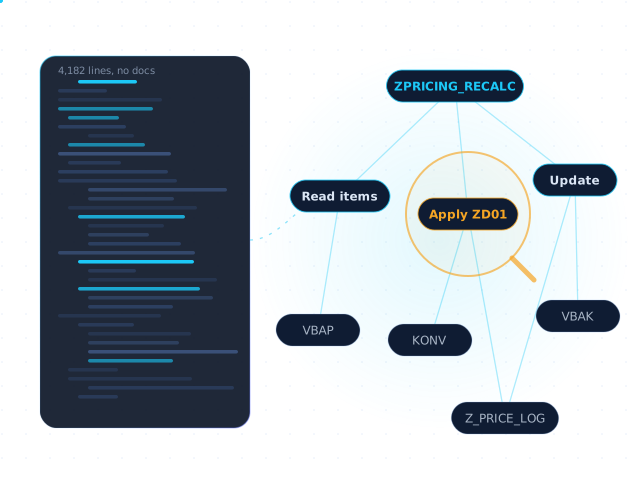
What Code Analyzer helps you see
- Program structure and organisation
- Processing flow and conditions
- Business logic, in business terms
- Dependencies in and out
- The sections that matter for your change
The program you inherited
* no header documentation
LOOP AT lt_items INTO ls_item.
  LOOP AT lt_kond INTO ls_kond
    WHERE knumh = ls_item-knumh.
    IF ls_kond-kschl = 'ZD01'.
      lv_net = lv_net - ls_kond-kbetr.
    ENDIF.
  ENDLOOP.
ENDLOOP.
In business terms
What this block does
Subtracts custom discount ZD01 from each line item’s net value — a per-line discount, not a header-level one.
Worth investigating
Conditions are read inside the item loop — the likeliest cause of slow runtimes on large orders.
Understand before you change.
Most change-related incidents aren’t mistakes in the change. They’re correct changes to code whose other responsibilities nobody noticed. Reading business logic is also a career skill, not just a maintenance one.
Questions about unfamiliar code
Start with the program on your desk.
Bring the object from the ticket you picked up this morning.
No SAP connection. No template rewrites.